Introduction
If you manage student Chromebooks, you have probably seen how easy it is to insert an image by URL in Google Docs . A student opens a Google Doc, goes to Insert, Image, and clicks By URL. They paste a web address, and the picture loads straight onto the page. No search. No new tab. Just a pasted link directing to any image. Generally, students use it normally. But it can also be an easy way to add a picture that has no place in schoolwork, pulled straight from any website.
Now try to turn that one option off for students. You open the Google Admin Console and look for a setting, but don't find one. The Admin Console offers no built-in way to remove just the By URL option without taking other image tools away too.
This post explains why that gap exists, where the By URL option appears across the Google Workspace, and how to disable Insert Image by URL for the student groups you choose with a single xFanatical Safe Doc's BlockAddImageByUrl policy.
How Students Insert Images by URL in Google Docs
Insert Image by URL is a built-in option in the Google Docs editors. With it, a student pastes a web address and the image loads directly into the file. They neither downloaded anything, nor left the google docs page.
In many cases, students use this option simply to add a picture to their work. The concern is narrow, but real. A student can also use it to pull in an off-task image, or one that does not belong to schoolwork, straight from a website and into the assignment. This usually comes up during projects, such as a Slides deck or an illustrated Doc, often on school chromebooks.
Two groups feel the impact: The IT admin who manages student accounts and the teacher who checks the work. The reason is simple. By URL is one of the built-in ways to add an image, and the Admin Console does not have a setting to turn off just that particular option for students. That leaves teachers with nothing just to catch and remove images manually.
In deployments we've supported, admins keep raising the same kind of gap. Students bring outside content into their Google Workspace work that the school’s normal web filter never sees. One school technology director told us Safe Doc helps them “control items that are not processed via normal web filtering, like image and video searches inside Google Apps.” Insert Image by URL is another route of this kind. A student can paste a web address straight into the file, and the web filter never gets a chance to check it.
If nothing changes, the problem stays. Students can keep adding outside images by URL, right inside the editor, and schools still have no way to remove it. None of the tools schools have can remove it either, they only work around it by flagging an image after it appears on the screen or blocking entire websites. But turning the feature off for everyone is not the answer. Plenty of people use it the right way. The real fix removes it only where it causes trouble and leaves it available everywhere else.

Insert Image by URL option open in the Google Docs editor, showing the field where a student pastes a web image address.
Understanding the Google Docs Insert Image by URL Control Gap
With no native switch for this one option, schools rely on the tools they already use. Each helps in its own way, but none reaches the By URL option.
Next are the web filters a school already uses. A web filter works at the website and network level, blocking entire sites. But By URL is an option inside the editor, so a web filter does not remove it. The option stays in the menu, and a student can still paste a link from any site the filter does not block.
One control gets closer, SafeSearch, which many schools already use and which is often turned on by default for K-12 students. A school can force it for a specific OU from the Admin Console, and it filters explicit results from Google image search. But By URL is not a search. A student who already has a direct image link from another site or a saved link can paste it straight into the editor. No search takes place, so SafeSearch never sees the link.
So what would a real fix look like? Five things:
- Remove the By URL option from the editor itself, not filter or block around it.
- Keep every other image tool working, upload, Drive, and Photos stay.
- Apply across the fleet, per organizational unit (OU), from the Admin Console not a per-device rule a student can switch off.
- Cover every place the By URL option appears, not just the main Insert menu.
- Scope to the group that needs it, and say which devices it reaches.
That is the gap Safe Doc's BlockAddImageByUrl policy is built to close.
Why Insert Image by URL Gets Past Your Filters
The Blind Spot: Why SafeSearch and Web Filters Never See a Pasted URL
To see why the usual controls miss this, look at where each one sits.
SafeSearch works at the search level. It checks what comes back from a Google search and filters out explicit results. A web filter works at the network level. It looks at the websites a device tries to reach and can block entire sites. Both are real controls, and both work well in their own place.
But Insert Image by URL works somewhere else. It is a feature inside the editor. The student does not run a search or open a blocked website in a new tab. They copy an image address from somewhere in google and paste it straight into the Doc. No search runs, so SafeSearch has nothing to check. The image loads inside the page, so the web filter has nothing to catch.
That is why a real fix has to work where the image actually enters: the editor itself.
How Safe Doc Actually Works
Safe Doc is a browser extension. When an administrator sets the BlockAddImageByUrl policy to true, Safe Doc looks at the editor interface, finds the By URL options, and removes them from the menu.
Here is Neeraj Nanvani, Development Director of Safe Doc at xFanatical Inc, on what the policy does:
"Safe Doc detects the relevant By URL options across Google Workspace interface and removes them from the UI. The policy is applied through the Safe Doc browser extension, rather than changing the Google Workspace service itself."
Two things here. First, Safe Doc works on the interface the menu the student actually sees which is exactly where the By URL option appears. Second, it does not change the Google Workspace service underneath. Google Docs keeps working as normal. Only the By URL option is removed.
The other ways to add an image stay available. A student can still upload an image from the device or add one from Drive or Photos. As our engineer puts it, the policy "only targets inserting images by URL and does not disable image insertion as a whole."
Disabling Insert Image by URL With Safe Doc in Google Workspace
The By URL option is not in just one place. The same option shows up across several Google Workspace apps and in more than one spot inside them. Safe Doc's BlockAddImageByUrl policy removes it from each.
Below are the before Safe Doc and after across Google Docs, Sheets, Slides, Drawings, and Gmail.
Block Insert Image by URL in Google Docs
In Google Docs, the By URL option is not in just one place. You can reach it in four different ways, and Safe Doc removes it from all four.
Each pair below shows the same place twice. Without Safe Doc, the By URL option is still there. With Safe Doc, it is gone. Every other way to add an image, Upload, Drive, Photos, and Camera stays available.
The Insert > Image > By URL menu in Google Docs removed by xFanatical Safe Doc
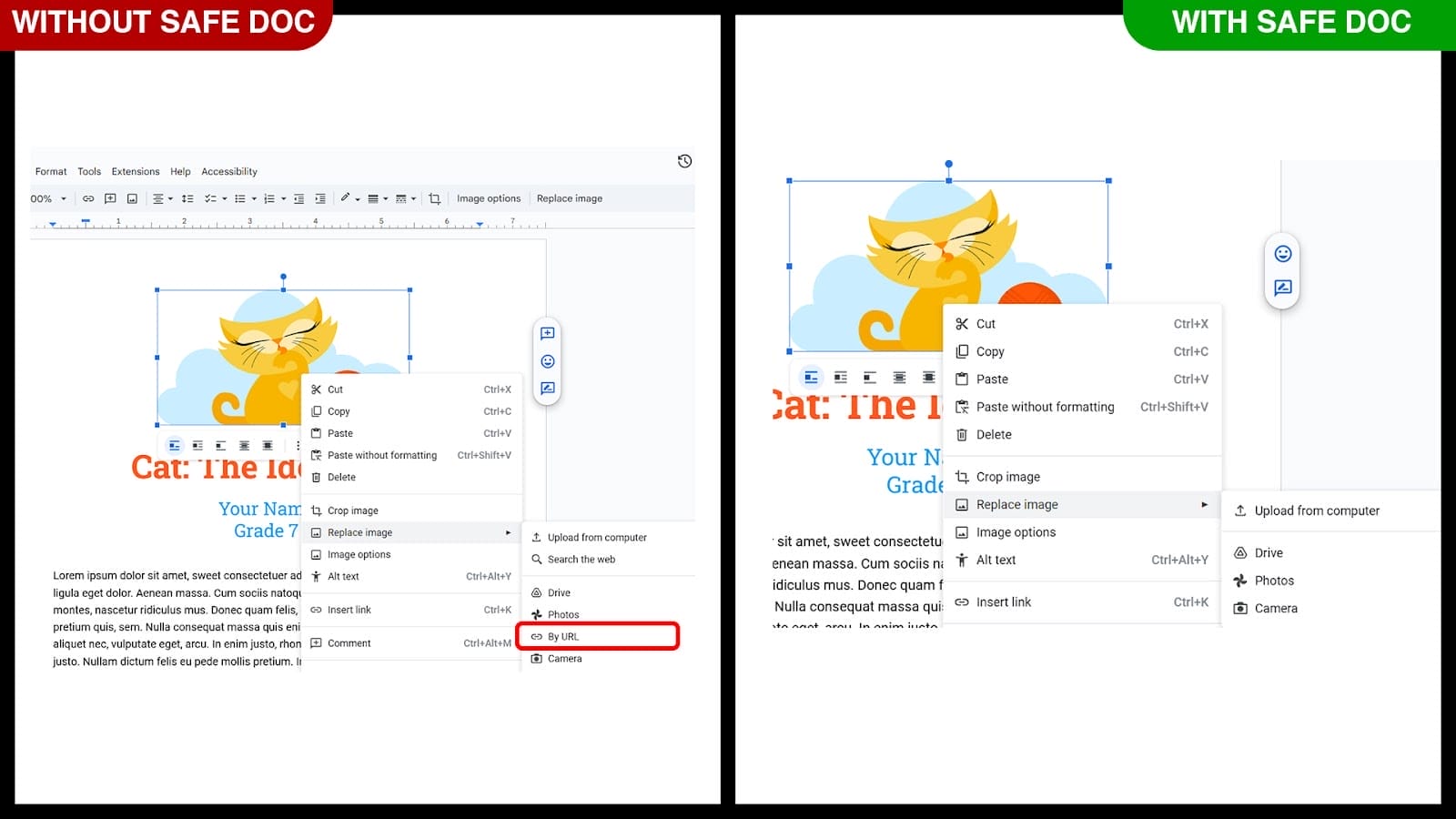
xFanatical Safe Doc removes the Replace image > By URL menu in Google in Google Docs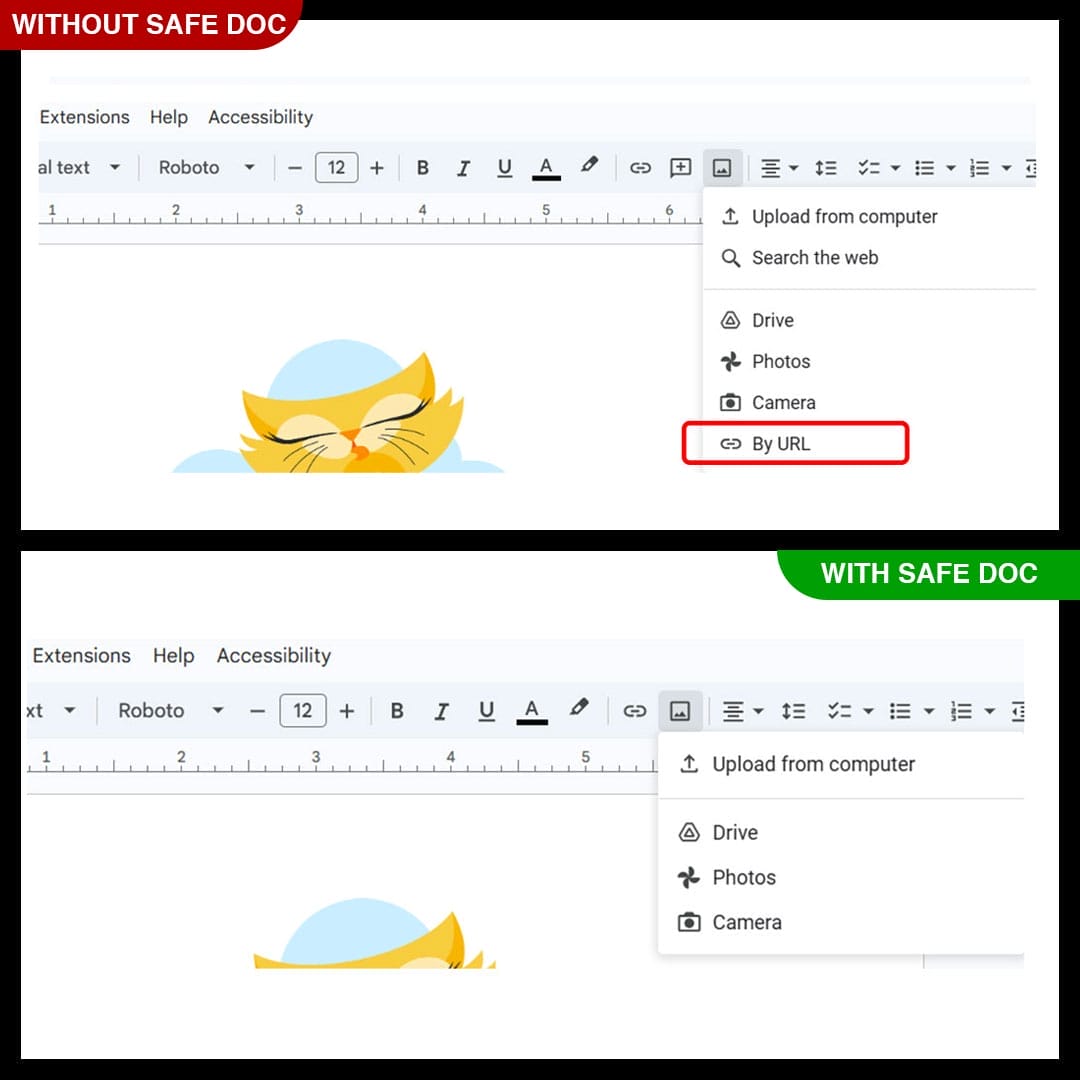
xFanatical Safe Doc removes the By URL menu in Google Docs
Disallow Insert Image By URL option in Google Sheets
Google Sheets’ Insert Image by URL feature allows users to pull images from external sources directly into their spreadsheets, providing flexibility in visual data representation. However, in educational environments, this feature can lead to misuse, resulting in distractions and the potential introduction of inappropriate content.
By implementing the BlockAddImageByUrl policy, you can prevent users from exploiting the Insert Image by URL feature in Google Sheets. Once this policy is set to true, the option to insert an image by URL will be removed from the Google Sheets editor, ensuring that students remain focused on their data analysis and use only approved visuals in their projects.
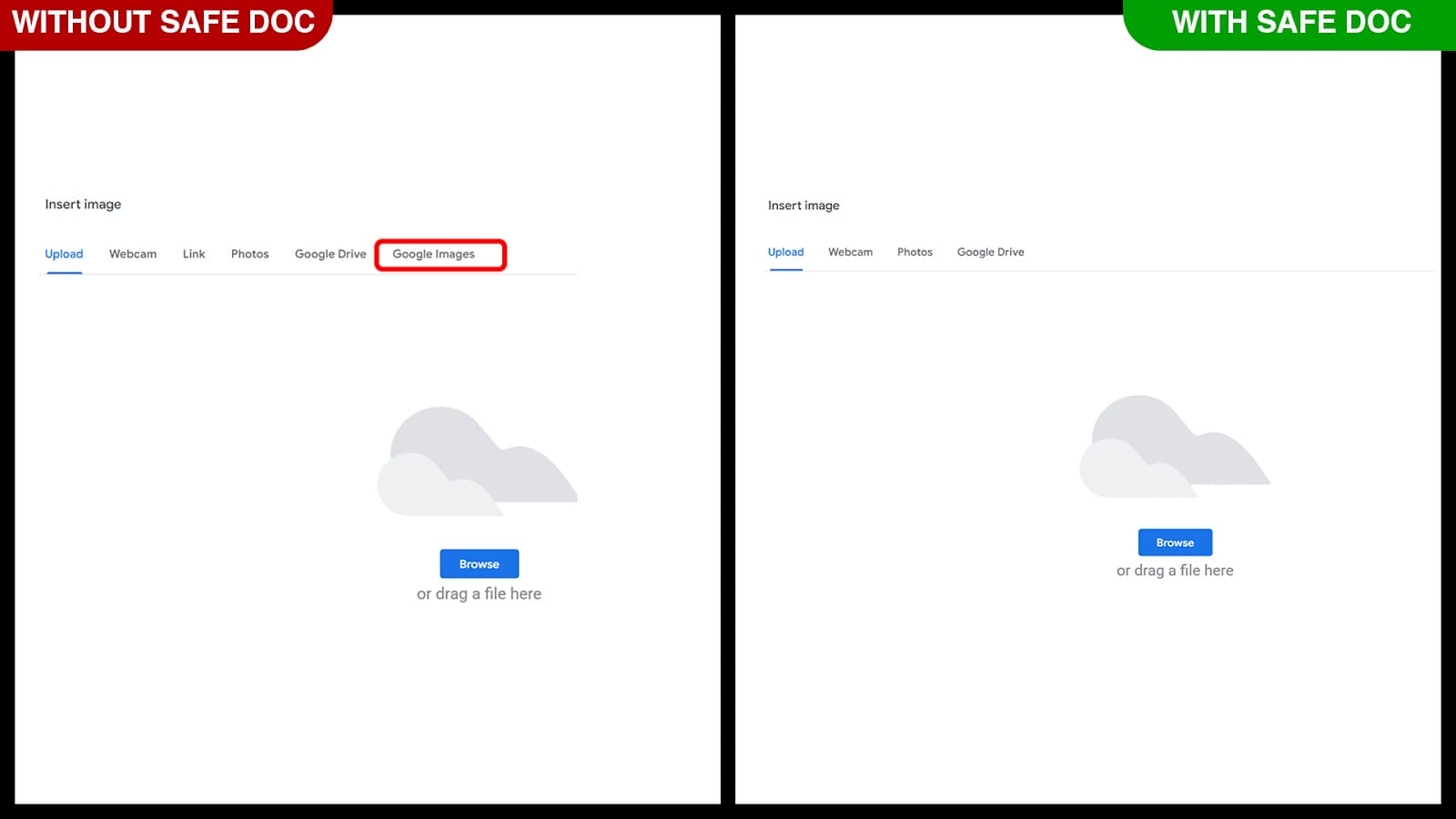
xFanatical Safe Doc removes the Insert > Insert Image over cell, Google images and link menus in Google Sheets
Inactivate Insert Image By URL option in Google Slides
Google Slides’ Insert Image by URL feature allows users to easily add images from online sources to their presentations, enhancing the visual appeal of their content. However, in educational settings, this capability can be misused, leading to distractions and the risk of including inappropriate or irrelevant images.

xFanatical Safe Doc removes the Insert > Image > By URL menu in Google Slides
xFanatical Safe Doc removes the By URL option in Google Slides
Constraint on the Insert Image By URL option in Google Drawings
Google Drawings’ Insert Image by URL feature allows users to incorporate images from external websites directly into their drawings, offering flexibility for creative projects. However, in educational environments, this feature can lead to misuse, resulting in distractions and the risk of including inappropriate or unrelated images.
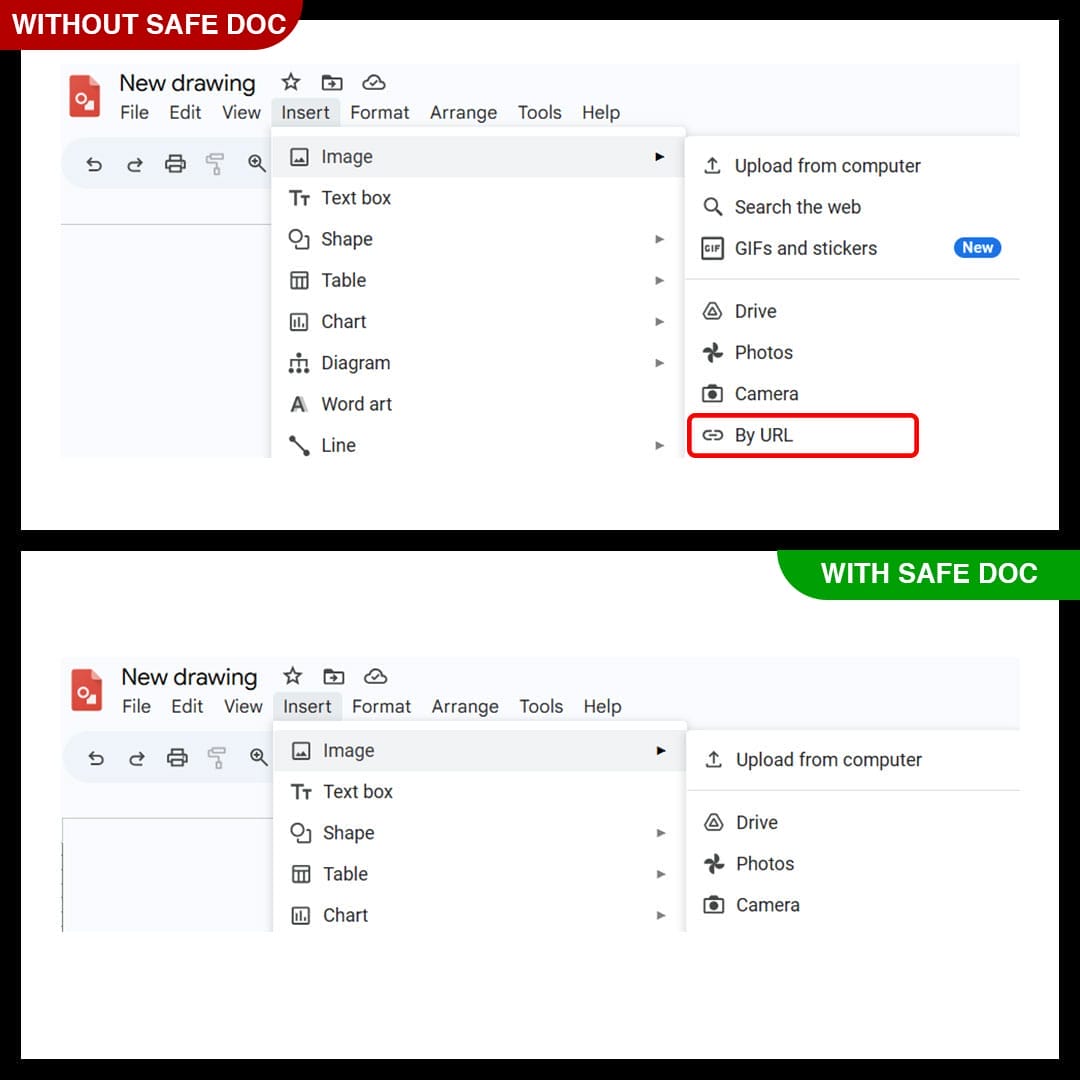
xFanatical Safe Doc removes the Insert > Image > By URL menu in Google Drawings

xFanatical Safe Doc removes the By URL menu in Google Drawings
Removed the By URL option in Google Drawings
Block Insert Image By URL in Gmail
Gmail's Insert Image by URL feature allows users to embed images from external sources directly into their emails, which can enhance communication with visuals. Moreover, this functionality can lead to potential misuse in educational settings and resulting in distractions or the risk of sharing inappropriate or irrelevant images.
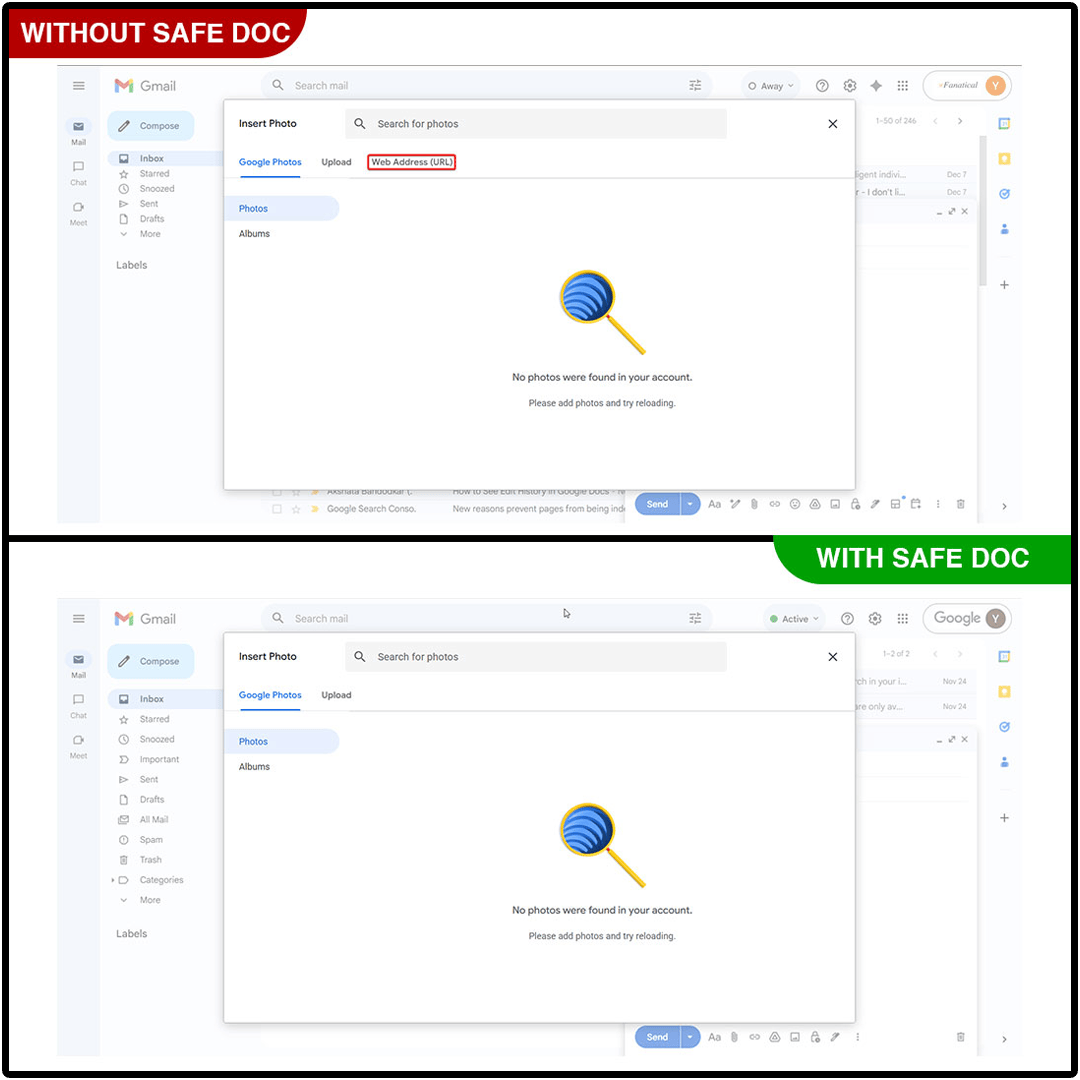
xFanatical Safe Doc removes the URL option in Gmail
Step-by-Step: How to Configure Safe Doc Policy
Step 1: Apply for a Free 30-day trial license key. The trial license and the sample policy configuration file will be emailed to you.
Step 2: Sign into the Google Admin Console and deploy xFanatical Safe Doc to the selected student organizational unit (OU). Full walkthrough: the Safe Doc deployment guide and the Safe Doc configuration reference.
Step 3: Go to Devices > Chrome > Apps & Extensions > Users & browsers, navigate to your Safe Doc policy configuration for the relevant organizational unit (OU).
Step 4: Click the xFanatical Safe Doc app.
Step 5: In the right-hand panel, under Policy for extensions, add and edit your policy configuration JSON to include “BlockAddImageByUrl ”.
"BlockAddImageByUrl": {
   "Value": true
}
Step 6: Click Save to apply the changes.
Step 7: Verify that the policy is active. Note: Wait a few minutes for the policy to be propagated to the students' devices. This can also take up to 24 hours.
Frequently Asked Questions
- Can you disable Insert Image by URL in Google Docs?
Yes. Safe Doc's BlockAddImageByUrl policy removes the By URL option, applied to the student groups you choose from the Admin Console. Google has no built-in setting that does this on its own. - Is there a native Google Admin Console setting to block image by URL?
No built-in setting was found that removes only the By URL option. The Admin Console does not split the image menu into separate parts, so schools need Safe Doc for this one control. - Does SafeSearch stop students adding images by URL?
No. SafeSearch filters Google Search results. A student pastes the image address straight in, so no search happens — and SafeSearch never sees the pasted link. - Which Google Workspace apps does BlockAddImageByUrl cover?
It removes the By URL option across Google Docs, Sheets, Slides, Drawings, and Gmail. The same single policy handles every one of them. - Does disabling Insert Image by URL block all images?
No. Only the By URL option is removed. Students can still add images by upload, Google Drive, and Photos — so normal work is not affected. - How do I enable the BlockAddImageByUrl policy?
In the Google Admin Console, set the policy to true through Safe Doc and apply it to the student OU. That is it — one setting, per group. - Do students need to restart Chrome after the policy is turned on?
No. If a page was already open, a reload may be needed for the option to disappear. No Chrome restart or new sign-in is required.
Conclusion
If students are pulling web images straight into their work, and no Admin Console setting seems to stop it, this is the gap Safe Doc closes. Set BlockAddImageByUrl to true, and the Insert Image by URL option comes out of Docs, Sheets, Slides, Drawings, and Gmail — for the students you choose. One setting, scoped per organizational unit (OU), working alongside the filter and monitoring you already run.
Start a free trial if you have not deployed it yet, or reach out and we will help you set it up across your fleet.
Related Safe Doc guides
Use the related-article block beneath the author card:
 xFanatical Safe Doc